

Introduction
In the last decade, the smartphone camera has evolved from a simple convenience to the primary reason people purchase a device. We have reached a point where the adage “the best camera is the one you have with you” has never been truer. Today’s smartphones are capable of producing professional-grade portraits, stunning low-light shots, and even cinematic video.
However, with manufacturers packing multiple lenses and throwing around terms like “megapixels” and “aperture,” choosing the right camera phone can be overwhelming. This guide breaks down the essential features, compares the top brands, and explains the technology behind the lens to help you make an informed decision.
How to Choose the Best Camera of a Smartphone?
When evaluating a smartphone camera, do not look solely at the megapixel count. Instead, consider these five critical factors:
- Megapixels (MP) vs. Sensor Size: While a higher MP count allows for more detail and cropping flexibility, sensor size is more important. A larger sensor (e.g., 1/1.28-inch) captures more light, resulting in better low-light performance, dynamic range, and natural background blur than a small sensor with a high MP count.
- Aperture (f/stop): Represented as f/1.8, f/1.5, etc., this is the opening in the lens that lets light in. A lower f-number (e.g., f/1.5) is better for low-light photography and creating a shallow depth of field (bokeh effect).
- Image Processing & Software: Hardware is only half the story. Modern smartphones rely heavily on computational photography. Brands like Apple, Google, and Samsung use advanced algorithms (e.g., Smart HDR, Night Sight) to process the raw data from the sensor. A phone with mediocre hardware but excellent software can often outperform one with great hardware but poor processing.
- Optical Image Stabilization (OIS): This is a must-have feature. OIS uses hardware to physically move the lens or sensor to counteract hand shake. It is essential for sharp photos in low light, stable video recording, and preventing blurry shots.
- Versatility (Lens Selection): A single lens is rarely enough today. Look for a combination of:
- Main (Wide): For everyday shots (usually the highest quality sensor).
- Ultrawide: For landscapes and group photos.
- Telephoto: For optical zoom portraits and distant subjects.
Which Company Smartphone is Best for Camera?
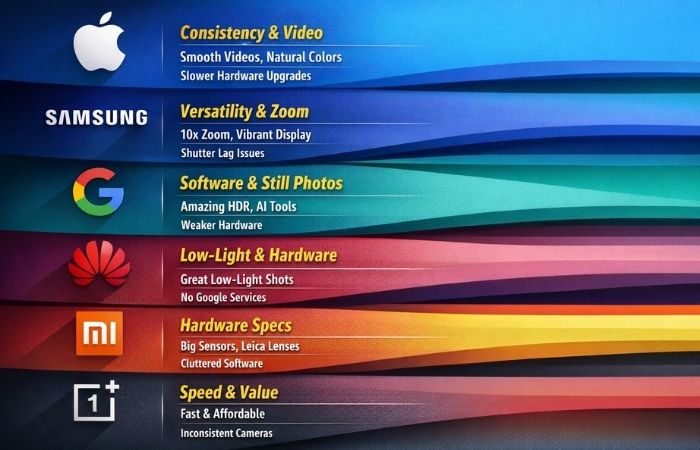
There is no single “best” brand, as each excels in different areas. Here is how the top manufacturers compare based on their strengths and typical user experience.
| Company | Best For | Strengths | Weaknesses |
|---|---|---|---|
| Apple (iPhone) | Consistency & Video | Industry-leading video stabilization, natural color science, seamless app integration, long software support. | Slower to adopt new hardware (e.g., zoom), fewer “pro” manual controls in native app. |
| Samsung | Versatility & Zoom | Best-in-class zoom capabilities (10x optical in Ultra models), vivid/saturated colors, excellent ultrawide lenses. | Shutter lag (difficult for moving subjects like pets/kids), occasional over-processing of skin tones. |
| Google (Pixel) | Software & Still Photos | Unmatched computational photography (Best HDR and Night Sight), accurate skin tones, useful AI features (Magic Eraser, Best Take). | Hardware often lags behind competitors; video quality is good but not class-leading. |
| Huawei | Low-Light & Hardware | Pioneered large variable apertures and large sensors (RYYB sensors) for insane low-light performance. | Lacks Google Services (in Western markets), which affects app usability for some. |
| Xiaomi | Hardware Specs | Often partners with Leica for color science; offers massive 1-inch type sensors found in dedicated cameras. | Inconsistent software processing; user interface (MIUI) can be cluttered. |
| OnePlus | Speed & Value | Fast shutter speed, clean interface (OxygenOS), good overall balance for the price. | Inconsistent across generations; struggles to match the “flagship killers” status in camera versus Pixels/iPhones. |
Various Companies with Best Camera Features

To help you compare specific flagship models currently on the market, here is a breakdown of the best camera phones and their defining hardware features.
| Model | Main Sensor | Unique Features | Zoom Capability | Video Max |
|---|---|---|---|---|
| iPhone 15 Pro Max | 48 MP (f/1.78) | Tetraprism Design, Log Color Encoding, Action Mode | 5x Optical (120mm) | 4K @ 60fps / ProRes |
| Samsung Galaxy S24 Ultra | 200 MP (f/1.7) | S-Pen integration, AI editing, High-resolution adaptive pixel | 5x Optical (10x via crop) & 10x Optical (legacy) | 8K @ 30fps |
| Google Pixel 8 Pro | 50 MP (f/1.68) | Best Take, Video Boost, Pro Controls, Thermometer Sensor | 5x Optical | 4K @ 60fps (with HDR+) |
| Xiaomi 14 Ultra | 50 MP 1-inch type (f/1.63) | Leica Summilux lenses, Variable Aperture (f/1.6-f/4.0) | 5x Optical Periscope | 8K @ 30fps |
| Huawei P60 Pro | 48 MP RYYB (f/1.4-f/4.0) | Ultra-Light-Scattering (Ultra Aperture), Physical Variable Aperture | 3.5x Optical (with long-range macro) | 4K @ 60fps |
Where to Buy: A Quick Guide
| Smartphone Model | Where to Buy | Key Highlights / Current Offers (as of March 2026) |
|---|---|---|
| Apple iPhone 16 Pro Max | Amazon India, Flipkart, Croma, Reliance Digital, Bajaj Finserv Partner Stores, Apple Authorised Resellers | ~₹1,35,900; No Cost EMI, 7-day service centre replacement |
| Samsung Galaxy S25 Ultra | Amazon India, Flipkart, Samsung India e-Store, Croma, Reliance Digital, JioMart | ~₹1,29,999; Bank discounts, exchange offers, No Cost EMI |
| Samsung Galaxy S24 Ultra | Amazon India (Best Discounts), Flipkart, Samsung India e-Store, Croma, JioMart | ~₹77,000-₹94,999; Bank discounts, exchange bonus up to ₹35,950 |
| Google Pixel 10 Pro / 9 Pro | Google Store India, Flipkart (Official Retail Partner), Croma, Reliance Digital | Direct from Google with “Pixel Price Promise”; Instant cashback, exchange bonus |
| Vivo X300 Pro | Vivo India e-Store, Flipkart, Croma, Reliance Digital, offline retail stores | ~₹1,09,999; Launch offers may include bank discounts and exchange bonuses |
| Xiaomi 15 Ultra / 15 | Amazon India, Xiaomi India e-Store, Flipkart, offline retail stores | ~₹1,09,999 (Ultra); ₹10,000-₹5,000 ICICI bank instant discount, free photography kit (pre-booking), No Cost EMI |
| Oppo Find X9 Pro | Oppo India e-Store, Flipkart, Amazon India, Croma, Reliance Digital, offline retail stores | ~₹1,09,999; Bank offers and exchange bonuses typically available |
| Mid-Range Options (Realme 15, Moto Edge 70, etc.) | Amazon India, Flipkart, brand e-stores, offline retail stores (Croma, Reliance Digital, Sangeetha, etc.) | ₹25,000 – ₹30,000; No Cost EMI and exchange offers |
Note: The Samsung Galaxy S24 Ultra is currently available at a significant discount (around ₹77,000 on JioMart) as it is the previous generation model, making it a great value-for-money camera phone .
Why Do Phones Have Many Cameras?
If you look at the back of a modern smartphone, you rarely see just one lens. This is not a gimmick; it is a solution to the physical limitations of a phone.
Because a smartphone is too thin to house a traditional optical zoom lens like a DSLR, manufacturers use multiple fixed lenses to mimic versatility. Each camera is a dedicated module:
- The Main (Wide) camera handles high-quality general shots.
- The Ultrawide camera fits a vast scene into the frame, equivalent to a 0.5x zoom.
- The Telephoto camera provides optical zoom (3x, 5x, or 10x) without losing quality, unlike digital zoom which just crops and enlarges the image.
- Additionally, dedicated Depth or ToF (Time of Flight) sensors are used to accurately map depth. This allows the software to separate the subject from the background for the artificial “Portrait Mode” bokeh effect.
In essence, multiple cameras allow a smartphone to cover the focal lengths of several professional lenses—from a 13mm ultrawide to a 120mm telephoto—within a single, pocketable device.
How Do Phone Cameras Work?
At its core, a smartphone camera works exactly like a traditional digital camera, just on a microscopic scale.
- Light Enters: Light passes through the lens (made of multiple layers of plastic or glass) and is controlled by the aperture (how wide the opening is) and the shutter (how long the sensor is exposed).
- The Sensor: The light hits the image sensor. This sensor is covered in millions of tiny “photosites” (pixels). The sensor converts the light photons into electrical signals. Pixel Binning is a common technique where phones like the Samsung 200MP sensor combine 16 pixels into one large “super pixel” to improve low-light sensitivity.
- Analog to Digital: The electrical signal is passed to the Image Signal Processor (ISP) —a dedicated chip inside the phone’s processor (like the Apple A17 Pro or Snapdragon 8 Gen 3).
- Computational Photography: This is where the magic happens. Unlike a DSLR which captures one frame, a smartphone captures multiple frames in a fraction of a second (an exposure bracket):
- An underexposed frame to save highlights (sky).
- A properly exposed frame for the mid-tones.
- An overexposed frame to bring out shadows.
- The ISP aligns these frames, fuses them together using AI, applies color science (like Leica or Zeiss profiles), and outputs a single High Dynamic Range (HDR) image. This process happens in milliseconds every time you press the shutter button.
Conclusion
Choosing the best smartphone camera comes down to your personal needs rather than just the highest spec sheet.
- If you are a videographer or prioritize consistent, accurate colors across social media apps, the Apple iPhone remains the industry standard.
- If you are a photographer who wants the most versatile zoom, AI editing tools, and vibrant colors, the Samsung Galaxy Ultra series is unmatched.
- If you want the best point-and-shoot still photography, especially of people and in low light, the Google Pixel offers the most intelligent software.
Ultimately, the best camera phone is the one that fits your budget and feels intuitive to use. Look for a large main sensor, Optical Image Stabilization (OIS), and a dedicated ultrawide or telephoto lens depending on what you like to shoot.
FAQs
Q1: Is a 108MP or 200MP camera better than a 48MP camera?
Not necessarily. While high megapixels allow for cropping, sensor size is more critical. A 48MP sensor that is physically large (like a 1/1.3-inch type) will usually take better low-light photos than a 108MP sensor that is physically small. Often, these high-MP cameras use “pixel binning” to output 12MP or 24MP images anyway.
Q2: What is the difference between Optical and Digital Zoom?
Optical Zoom uses the physical telephoto lens to magnify the image, resulting in no loss of quality. Digital Zoom simply crops into the existing photo and enlarges the pixels, resulting in a grainy, blurry image. Always prioritize a phone with a dedicated telephoto lens if you shoot distant subjects.
Q3: Are more cameras always better?
No. A phone with four cameras (Main, Ultrawide, Telephoto, Macro) can be worse than a phone with three cameras if the sensors are low quality. Often, “macro” lenses are 2MP gimmicks. It is better to have three high-quality cameras than four mediocre ones.
Q4: Which phone is best for taking pictures of moving subjects (kids/pets)?
Google Pixel phones generally have the fastest shutter response and best software for freezing motion (Top Shot feature). Apple iPhones are also reliable. Samsung phones, while excellent for still subjects, historically suffer from slight shutter lag, making it harder to capture fast-moving kids or pets without blur.
Q5: Does the camera app matter?
Yes. If you use third-party apps like Instagram, Snapchat, or TikTok, iPhone usually offers the best integration because these apps use the native camera API (meaning they take a real photo, not a screen recording of the viewfinder). On Android, the quality in third-party apps can sometimes degrade compared to the native camera app.
